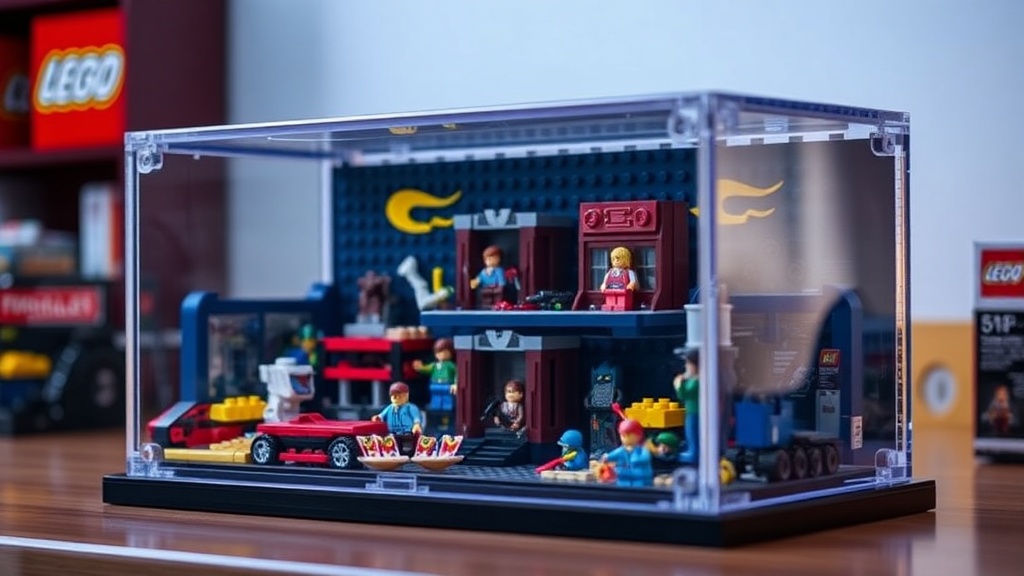
Selecting the Right Acrylic Cases for Your LEGO Sets

Are you tired of seeing a thin layer of dust settling into the crevices of your UCS Millennium Falcon? Choosing the right display case is about more than just aesthetics; it's about long-term preservation and maintaining the resale value of your investment. This guide breaks down the different types of acrylic housings, material quality, and sizing requirements so you can protect your builds from dust, moisture, and UV rays.
What Type of Acrylic Should You Use?
High-quality, UV-resistant acrylic is the gold standard for protecting LEGO sets from environmental damage. While many cheap options use standard polystyrene or low-grade plastics, true collectors look for polymethyl methacrylate (PMMA). This material offers much better clarity and won't turn yellow or brittle over time when exposed to light.
If you're displaying a set near a window, the material choice becomes even more important. Standard plastic often lacks the UV inhibitors found in high-end acrylic. This can lead to more than just a dusty shelf; it can actually lead to fading colors on your bricks. If you haven't already looked into how light affects your builds, you should check out my guide on protecting minifigure paint from UV damage.
There are two main ways to approach this: custom-built boxes or modular display cases. Custom cases are often built to the exact dimensions of a specific set, like a LEGO Star Wars UCS set. Modular cases, however, allow you to scale your collection as you grow.
Comparing Case Materials
| Material Type | Clarity | UV Resistance | Durability | Best For |
|---|---|---|---|---|
| Standard Acrylic | High | Moderate | Good | Standard Display |
| UV-Resistant Acrylic | Excellent | Very High | High | Window-side Displays |
| Polystyrene (Cheap Plastic) | Fair | Low | Brittle | Temporary Storage |
| Glass | Perfect | High | Fragile | Museum-style Exhibits |
How Do I Measure for a LEGO Case?
Measure the widest point of your LEGO build and add at least two inches (5 cm) to both the length and width to allow for "breathing room." You don't want your set touching the walls of the case, as this can lead to scratches or even structural stress if the set is heavy. If you're building a large model, like the Titanic or a large modular building, the weight of the model itself is a factor you can't ignore.
Don't just measure the baseplate. Look at the highest point of the build—the "peak"—and the widest overhangs. A common mistake is buying a case that fits the footprint perfectly but is too short for the build's height. This results in a cramped, ugly look that ruins the premium feel of the set.
Here is a quick checklist for measuring your sets:
- Width: Measure from the furthest left stud to the furthest right stud.
- Depth: Measure from the front-most element to the back-most element.
- Height: Measure from the baseplate to the highest point of the build.
- Clearance: Add 2 inches to each dimension for a professional look.
If you're displaying a set with many "loose" parts or many minifigures, consider the volume. A set might be short but very wide. A taller, narrower case might look awkward if the proportions are off. Always aim for a "golden ratio" where the case feels slightly larger than the build, not a tight coffin.
Which Case Style Best Suits My Collection?
The best case style depends on whether you prioritize ease of access or maximum protection. Most collectors fall into one of three categories: the "Modular Builder," the "Display Case Enthusiast," or the "Custom Order Specialist."
For most people, a top-loading box is the easiest to live with. You lift the lid, place your set inside, and snap it shut. These are great for sets you might want to take apart occasionally. However, they can be a bit cumbersome if you have dozens of them.
Front-loading cases are better for high-end displays. They often feature a hinged door or a sliding mechanism. These look much cleaner on a bookshelf or inside a glass cabinet. They provide a more "museum" feel, but they take up more depth on your shelf because of the hinge mechanism. If you have a massive collection, you might want to look into modular stacking systems. These are often used by people who collect LEGO Star Wars or certain modular buildings. You can stack them vertically to save space. Just remember that stacking adds weight, so the bottom case needs to be sturdy. You can read more about the nuances of storage in my post on how to properly store and display your LEGO collection.
The choice is really about how often you interact with the set. If it's a "set it and forget it" build, go for a sealed, top-loading box. If it's a centerpiece you want to show off, a front-loading case with a hinge is a better bet.
Pros and Cons of Popular Display Methods
- Individual Acrylic Boxes:
- Pros: Maximum protection, looks premium, great for single-set focus.
- Cons: Expensive for large collections, takes up a lot of shelf space.
- Display Cabinets (IKEA Detolf style):
- Pros: Can hold many sets at once, easier to organize.
- Cons: Dust can still get in through gaps, no individual UV protection.
- Custom Acrylic Covers:
- Pros: Perfect fit, looks incredibly professional.
- Cons: High cost, requires precise measurements, often non-returnable.
One thing to keep in mind: don't forget about the base. Many high-end acrylic cases come with a baseplate or a solid bottom. If you're buying a case that is just a "cover" (the five-sided box), you'll need to ensure the surface it sits on is perfectly flat and level. A slight tilt can cause a large model to slowly "drift" or lean over time.
If you're using a standard shelf, you might want to add a small amount of museum wax (a clear, non-damaging adhesive) to the bottom of your LEGO baseplate to keep it centered. It's a small detail, but it prevents the build from shifting if the case is bumped.
For more information on material safety and chemical properties of plastics, you can check out the Wikipedia page on Acrylic to understand the differences in polymer structures. This can help you decide if a specific brand's product is worth the premium price.
When you're looking at different brands, don't just look at the price. Look at the thickness of the acrylic. A 3mm thickness is standard for small sets, but for something massive like a LEGO Star Wars UCS Imperial Star Destroyer, you'll want something much more substantial. A thin, flimsy case can bow under its own weight or the weight of the air pressure changes in a room. This looks cheap and can even lead to the case cracking.
The goal is to create a display that looks like it belongs in a gallery, not a storage bin. A well-chosen case makes the difference between a "toy on a shelf" and a "collector's piece."